
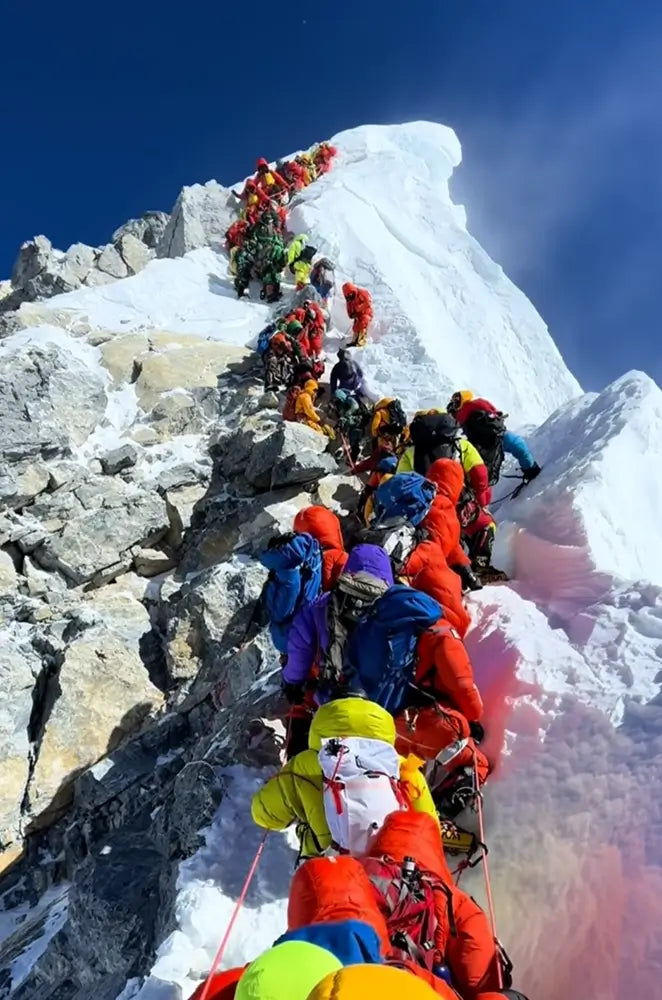
When people first see photos of a queue near the summit of Everest, the reaction is often disbelief. The highest mountain on Earth, more than 8848 metres above sea level, appears to have a line like a busy tourist attraction.
So why are Everest queues so dangerous? If everyone is clipped into the fixed rope, can’t they just wait?
No. A queue on Everest is not an ordinary queue. It happens in the death zone, in severe cold, high wind and thin air, with limited oxygen and limited strength. At sea level, waiting costs time. High on Everest, waiting costs heat, oxygen, energy and judgement.
Quick Answer
Everest queues are dangerous because:
- They often happen above 8000 metres in the death zone
- Climbers use oxygen even while standing still
- Oxygen bottles have limited duration
- Cold and wind increase frostbite risk
- Delays can push climbers past safe turnaround times
- Narrow ridges and fixed ropes limit overtaking
- Fatigue and hypoxia make small mistakes serious
- Queues during descent are especially dangerous
The real problem is not simply “too many people”. It is too many people in a place with almost no margin for error.

Why Does Everest Get Crowded
Everest queues usually come from several factors happening together.
The Weather Window Is Short
Most Everest summit attempts happen in May, before the monsoon. Teams wait for a short period when the jet stream weakens, wind drops, snowfall eases and visibility improves. If a season has only two or three good summit days, many teams will naturally move at the same time.
It is like a bridge that opens for only a few hours. Everyone tries to cross. On Everest, that bridge is the narrow route from Camp 4 to the summit and back.
The Route Is Narrow
On the Nepal side, climbers leave the South Col and pass areas such as the Balcony, the South Summit and the summit ridge. Many sections are steep snow, mixed rock and snow, or narrow ridge. Climbers often move on one fixed rope line.
The north side has similar issues, with ridges, steps and fixed rope bottlenecks. There is limited room to pass, and climbers going up and down may meet near the same line.
Commercial Expeditions Concentrate Numbers
Modern Everest expeditions allow more people to attempt the mountain. Fixed ropes, oxygen, Sherpa support and mature logistics have lowered some barriers. But not every climber moves at the same speed, and not every operator applies the same safety discipline.
When climbers of very different ability enter the same fixed-rope system, bottlenecks become more likely.

Why Queues in the Death Zone Are Serious
The most dangerous Everest queues occur on the summit route, close to or above 8000 metres.
At this altitude, the body is already failing to adapt. Even with supplemental oxygen, climbers move slowly, get cold and think less clearly. National Geographic has connected Everest crowding with weather windows and death-zone risk. Outside has also reported on the famous 2019 Everest queue photo and the long waits some climbers faced near critical points.
At low altitude, a two-hour wait is annoying. High on Everest, two hours can mean:
- Faster oxygen use
- Higher frostbite risk
- Loss of body heat
- Later descent
- Movement after dark
- Poorer decision-making
- More confused team management
Everest is not a place where people can casually “wait a bit longer”.
Why Oxygen Makes Delays More Dangerous
Most commercial Everest climbers use supplemental oxygen. Bottles are positioned according to a plan, and flow rates are usually calculated before the summit push.
That plan depends on expected speed. A team may estimate how long it takes to move from Camp 4 to the summit, where bottles will be changed and how much oxygen each section requires.
A queue can break that plan. A bottle expected to last until the South Summit may run low after a long delay below a bottleneck.
CBS News reported during the 2019 Everest crowding season that running out of oxygen in the death zone is extremely dangerous. The reason is simple: severe hypoxia affects both the body and brain. A climber may go from moving slowly to needing help to descend.
And high on Everest, helping a climber who can no longer move is one of the hardest situations on the mountain.
Frostbite Risk Increases
When climbers queue, they cannot keep a normal rhythm. They may stand in wind, feet fixed on snow, hands on the rope, producing less heat.
Everest is already cold. Add wind chill, and fingers, toes, nose and cheeks become vulnerable. Movement helps the body generate heat. Waiting removes that advantage. Tight boots, damp socks, cold gloves, low oxygen or poor circulation all make the problem worse.
Everest accidents are not only falls or avalanches. Frostbite, hypothermia, fatigue and hypoxia often combine.
Descent Matters More Than the Summit
The most dangerous queues may happen not on the way up, but on the way down.
After summiting, climbers are already tired. The emotional high begins to fade. Now they must return along the same route. If they meet a queue, the situation can be worse:
- They have less energy
- Oxygen reserves may be lower
- Weather may be changing
- Daylight may be fading
- Upward and downward traffic may conflict
- Slow or struggling climbers may block movement
There is an old Everest truth: reaching the summit is only half the climb. Success means coming back alive. Any delay that slows descent threatens that second half.
Fixed Ropes Are Safe but Can Create Bottlenecks
Fixed ropes are central to modern Everest climbing. They allow climbers to use ascenders, safety clips and rope systems on steep or exposed terrain.
But fixed ropes can also create a single-lane route. Many places cannot safely hold several climbers side by side. You cannot always unclip and overtake. If someone ahead stops to adjust oxygen, fix gear, rest or move slowly, everyone behind may have to wait.
This does not mean fixed ropes are bad. It means the system needs good spacing, appropriate climber ability, strict turnaround rules and careful summit timing.
Why Guides Set Turnaround Times
A turnaround time is one of the most important safety rules on Everest. If a climber has not reached a certain point by a certain time, they must descend, even if the summit looks close.
Queues make this psychologically hard. The summit may be visible. Other people may still be moving. A climber may think: “I have come this far. How can I turn around now?”
But a guide is looking at the whole picture: oxygen, weather, speed, daylight, descent difficulty and the climber’s condition. If the safe time has passed, continuing to wait means trading descent safety for a summit photo.
A responsible expedition does not put summit statistics above life.
Can Everest Crowding Be Solved
It is hard to solve completely, but the risk can be reduced.
Stricter Climber Screening
Inexperienced or very slow climbers can affect the whole route. Higher experience standards can reduce bottlenecks and improve safety.
Staggered Summit Timing
Teams can leave at different times based on weather, route conditions and team speed. But if the window is extremely short, there may be limited room to spread out.
Better Route Management
Clearer up-and-down systems, better management of key points and stronger team coordination can reduce local jams.
Firm Turnaround Rules
This is one of the most practical tools. Crowding is dangerous, but the danger becomes worse when climbers refuse to turn around after the safe window has passed.
Permit Limits
Some people argue for limiting the number of permits. This may reduce crowding, but it also affects national revenue, local jobs, expedition companies and access fairness. It is not a simple technical fix.
How Ordinary Readers Should Understand Everest Queue Photos
Everest queue photos are easy to mock. They can make the mountain look like a tourist attraction. That criticism has some truth, but it can also be too simple.
Behind the photo are weather windows, narrow terrain, commercial mountaineering, personal ambition, government policy, local economy and the risks taken by high-altitude workers. A single image cannot explain the whole system.
A better reading is this: Everest queues reveal the tension inside modern commercial climbing. More people want to stand on the highest point on Earth, but the mountain has not become wider, warmer or safer.
Advice for Future Everest Climbers
If Everest is your goal, ask operators better questions:
- How do you choose summit day?
- Do you stagger departure times?
- What is the guide-to-client ratio?
- What turnaround times do you enforce?
- What happens if the route is blocked?
- Does the oxygen plan account for delays?
- Is spare oxygen available during descent?
- Must clients prove fixed-rope skills?
- Do you accept climbers with no high-altitude experience?
These questions are more useful than “What is your summit success rate?” Success rates describe the past. Risk management describes how the team will behave when the mountain becomes complicated.
Conclusion
Why are Everest queues dangerous? Because they happen at an altitude where people cannot safely wait for long. In the death zone, every minute consumes oxygen, heat, strength and judgement. Narrow terrain, fixed ropes, short weather windows and many climbers can turn waiting into part of an accident chain.
The most important lesson from Everest traffic jams is not that the photos look strange. It is that no commercial system can change the basic rules of extreme altitude.
On Everest, the people in front of you are not the only queue. You are also waiting behind time, weather and the limits of the human body.

Leave a comment
All comments are moderated before being published.
This site is protected by hCaptcha and the hCaptcha Privacy Policy and Terms of Service apply.