
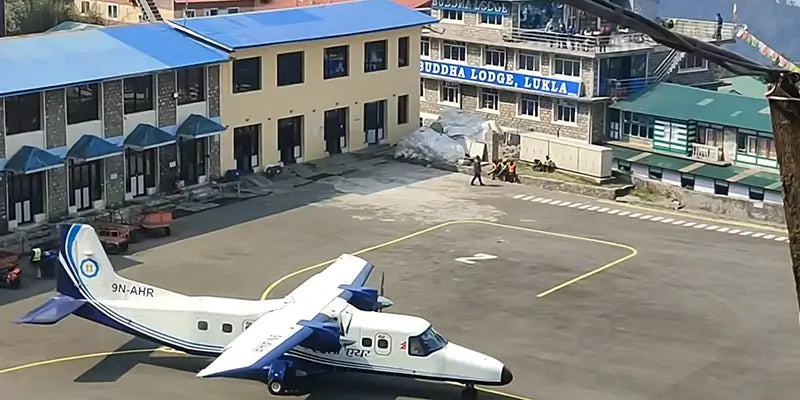
Before the Everest Base Camp Trek properly begins, many trekkers face the first real test: flying to Lukla.
Lukla’s Tenzing Hillary Airport sits at around 2860 metres in the Khumbu region. It is the main gateway for Everest Base Camp, Gokyo Lakes and Three Passes treks. For many people, landing in Lukla feels like the true beginning of the Everest journey.
But Lukla flights are famous for a reason. The runway is short, mountain weather changes quickly, delays are common, and in peak season flights often operate from Ramechhap instead of Kathmandu. If you do not plan for this, your EBC trek can become stressful before you start walking.
Quick Answer
There are usually two ways to fly to Lukla for the Everest Base Camp Trek:
- Kathmandu to Lukla, usually around 30 to 40 minutes
- Kathmandu road transfer to Ramechhap, then Ramechhap to Lukla, usually around 15 to 25 minutes flying
During busy trekking seasons, many Lukla flights operate from Ramechhap or Manthali Airport. The common baggage allowance is about 10 kg checked luggage plus 5 kg hand carry, for a total of 15 kg. Flights are highly weather dependent, so EBC itineraries should include at least 1 to 2 buffer days.
In simple terms, a Lukla flight is not a normal domestic flight. It is one of the most flexible parts of the Everest Base Camp plan.
Why Most Trekkers Fly to Lukla
Without flying to Lukla, trekkers need to begin much lower and spend extra days walking or driving into the Khumbu region. That can be a good option for people with more time, but it does not fit most standard EBC itineraries.
Flying to Lukla offers:
- Time saving
- Fast access to the Everest region
- Direct start of the classic EBC route
- Compatibility with 12 to 14 day itineraries
- Mature teahouse, guide and porter systems
Most trekkers have limited holiday time, so flying to Lukla remains the standard choice.
Kathmandu to Lukla Flight
The traditional route is Kathmandu to Lukla. Himalayan Glacier describes the flight as around 30 to 40 minutes. In good weather, it is a beautiful mountain flight over valleys, villages and distant peaks.
But direct Kathmandu flights are not always available or convenient year-round. During peak seasons, many Lukla flights shift to Ramechhap to reduce pressure at Kathmandu airport.
Advantages of Kathmandu to Lukla:
- No early road transfer to Ramechhap
- Less tiring overall
- More comfortable after arriving in Nepal
- Simpler luggage and transport
Disadvantages:
- Limited or unavailable in some peak periods
- Often more expensive
- More affected by Kathmandu airport congestion
Ramechhap to Lukla Flight
Many recent EBC trekkers now follow this pattern: drive from Kathmandu to Ramechhap or Manthali Airport, then fly to Lukla.
Recent sources describe the Kathmandu to Ramechhap drive as around 4 to 5 hours. Many groups leave between 1 am and 3 am to catch morning flights. Namaste Nepal Trekking suggests starting very early, around 2 am, if driving from Kathmandu to Ramechhap for a morning Lukla flight.
Advantages of Ramechhap to Lukla:
- More common in peak season
- Shorter flight time
- Often better flight scheduling for Lukla
- Less pressure from Kathmandu airport traffic
Disadvantages:
- Very early wake-up
- Tiring road journey
- Poor sleep before the first trekking day
- More logistics around luggage and timing
If your itinerary says Ramechhap to Lukla, do not be surprised. It is now very common in busy EBC seasons.
Why Lukla Flights Are Often Delayed
Lukla delays are not simply airline inconvenience. The route is genuinely weather sensitive.
Factors include:
- Cloud
- Visibility
- Wind
- Mountain air currents
- Rain or snow
- Airport congestion
- Aircraft turnaround
- Weather at both departure and arrival airports
Lukla’s runway is short and surrounded by mountain terrain. Pilots need suitable visibility and stable conditions. When the weather is poor, flights may be delayed for hours or cancelled for the day.
This is why your EBC schedule should not be too tight. You can train your legs and buy good gear, but you cannot control the weather in Lukla.
When Are Flights Most Affected
There is no perfect rule, but generally:
- Spring and autumn have more flights, but more passengers
- Monsoon brings more cloud and rain
- Winter may have clear skies but cold and wind
- Morning flights are usually better than afternoon flights
- After several bad-weather days, passenger backlog becomes a problem
Many Lukla flights are scheduled early because mountain weather often becomes less stable later in the day. The early start is tiring, but it has a reason.
Baggage Allowance
Lukla flights use small STOL aircraft, so luggage limits are strict. Several recent sources list the common allowance as 10 kg checked luggage plus 5 kg hand carry, for 15 kg total. Marvel Adventure and Discovery World Trekking both describe similar limits.
This means you cannot pack like you would for an international flight. Duffel, daypack, camera, batteries, clothing and sleeping bag all count.
Tips:
- Keep your main duffel around 10 kg
- Keep hand carry around 5 kg
- Carry valuables, medicine and documents with you
- Do not pack power banks in checked luggage
- Confirm the airline’s latest rules
- Extra weight may not always be accepted, even if you pay
If aircraft weight is tight, overweight luggage may be delayed. Starting EBC without your sleeping bag or down jacket is not ideal.
How Much Does the Lukla Flight Cost
Prices change by departure airport, airline, season and booking method. Trek and Adventure Nepal’s 2026 guide lists Ramechhap to Lukla flights at about USD 180 to 200 one way, and Kathmandu to Lukla at about USD 250 to 350. Always confirm current prices when booking.
A rough budget:
- Ramechhap return flights: around USD 360 to 450
- Kathmandu return flights: often higher
- Add road transfer cost to Ramechhap
- Add possible delay costs for food, hotels or changed tickets
Do not compare ticket prices only. Ramechhap also involves road transport, early departure and possible extra hotel costs.
How Many Buffer Days Do You Need
At least 1 to 2 days. If possible, 2 to 3 days is better.
Buffer days can cover:
- Lukla return flight delays
- Ramechhap road transfer changes
- Recovery during the trek
- Slower pace due to altitude symptoms
- International flight connections
- Baggage or weather problems
The worst plan is flying from Lukla today and leaving Nepal internationally tomorrow. One cancelled Lukla day can create real stress.
Good EBC itineraries build in flexibility.
What If the Lukla Flight Is Cancelled
Common options include:
Wait for the Next Flight or Next Day
This is the usual response. If weather improves, flights may resume.
Adjust Between Ramechhap and Kathmandu
Sometimes departure airports or schedules shift. Guides or agents can help manage this.
Helicopter
Some trekkers choose a helicopter if time is tight, but it is expensive and still weather dependent.
Walk Out
If flights are cancelled for several days, walking toward Jiri or Salleri and using road transport may be possible, but it requires extra days and energy.
Change International Flights
If weather continues, you may need to change international flights. This is why delay insurance matters.
Is a Helicopter Return Worth It
Some EBC itineraries include a helicopter return from Gorak Shep or nearby areas to save time. It is convenient for trekkers with high budgets, tight schedules or limited descent capacity.
But remember:
- Helicopters are expensive
- Weather still matters
- High altitude, load and wind may change pickup location
- Descent by helicopter is not necessary for most trekkers
- Emergency helicopter use requires insurance and documentation
A helicopter return is a comfort upgrade, not a standard EBC requirement. For a first EBC trek, walking back down is often the fuller experience unless time or health says otherwise.
What If You Are Nervous About the Lukla Flight
Many trekkers feel nervous. Lukla is famous for its short runway and mountain setting, but it is also a working gateway to the Everest region. In peak season, many flights operate, and pilots are experienced in mountain flying.
What you can do:
- Use reputable airlines and agencies
- Accept weather delays instead of pushing to fly
- Travel in main trekking seasons
- Take morning flights where possible
- Wear your seatbelt
- Secure hand luggage
- Remember that cancellation is often the safe decision
A cancelled flight is annoying, but it usually means the safety system is doing its job.
How to Pack for the Lukla Flight
Because the common total weight is around 15 kg, pack for that limit from the start.
Prioritise:
- Wear trekking boots on the flight
- Down jacket
- Sleeping bag
- Waterproof shell
- Warm layers
- Gloves and hat
- Medicine
- Documents
- Headlamp
- Power bank
- Small snacks
Reduce:
- City clothes
- Extra shoes
- Large toiletries
- Heavy camera accessories
- Too many snacks
- Laptop
- Unnecessary backup gear
EBC is not a relocation project. Every kilogram matters for the flight, porters and your own daypack.
Practical Advice for First-Time EBC Trekkers
Confirm whether your flight leaves from Kathmandu or Ramechhap.
Do not assume Kathmandu direct flights in peak season.
Keep at least 1 to 2 buffer days at the end.
Pack within the 15 kg common limit.
Carry valuables and medicine in hand luggage.
Sleep early before a Ramechhap transfer.
Do not schedule international flights too tightly.
Buy insurance that covers delays and trip interruption.
Listen to your guide and airline staff during cancellations.
Treat delays as part of the Everest region, not personal bad luck.
Conclusion
The Lukla flight is one of the most distinctive and unpredictable parts of the Everest Base Camp Trek. It takes you from the city toward the Khumbu, but it can also challenge your schedule with weather, baggage limits, airport changes and delays.
When planning EBC, do not only train and buy gear. Build flexibility into transport. Understand the Ramechhap transfer, keep luggage light, add buffer days and accept that mountain flights work on mountain terms.
Landing in Lukla is exciting. But the smartest trekkers begin respecting the Himalayan rhythm long before the plane leaves the ground.

Leave a comment
All comments are moderated before being published.
This site is protected by hCaptcha and the hCaptcha Privacy Policy and Terms of Service apply.