
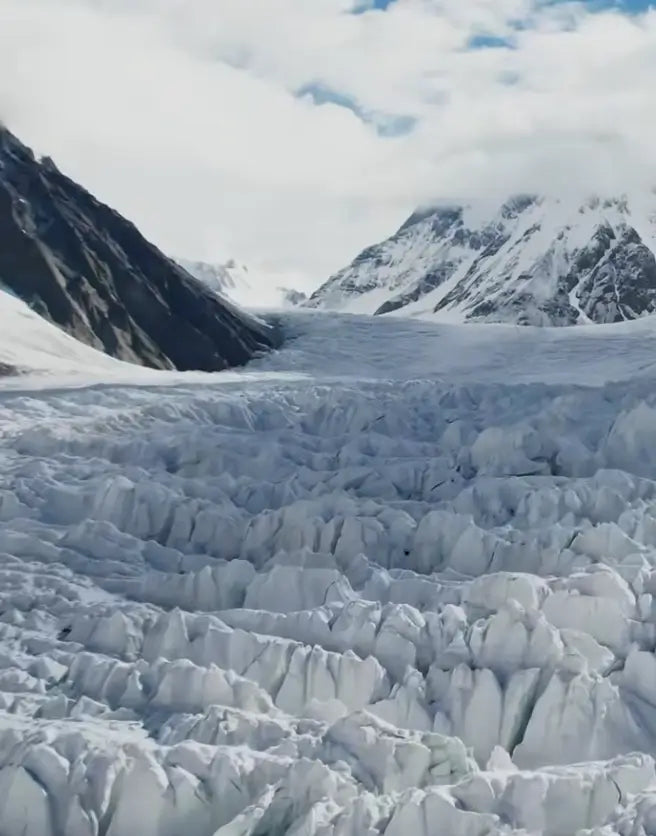
Mount Everest is the highest mountain on Earth. K2 is the second highest. That part is easy.
But when climbers compare the two, the conversation rarely stops at height. The real question is more complicated: which one is harder to climb, which one is more dangerous, and why do so many experienced mountaineers speak about the Karakoram giant with such deep respect?
Everest is taller, more famous, and more commercialized. The second-highest mountain is lower by a few hundred meters, but it is steeper, more technical, more remote, and often less forgiving. One represents the highest point a person can stand on. The other represents one of the purest tests in high-altitude climbing.
Quick Comparison
| Feature | Mount Everest | The Karakoram Giant |
|---|---|---|
| Height | 8,848.86 m / 29,031.7 ft | 8,611 m / 28,251 ft |
| Global rank | Highest mountain in the world | Second-highest mountain in the world |
| Main range | Himalaya | Karakoram |
| Common standard route | South Col / North Col | Abruzzi Spur |
| Public fame | Extremely high | High among climbers |
| Commercial infrastructure | More developed | More limited |
| Technical difficulty | Serious but more standardized | Steeper and more sustained |
| Overall character | Altitude and crowds | Steepness, remoteness, consequence |
Which Mountain Is Higher?
Mount Everest is higher.
Its accepted elevation is 8,848.86 meters, while Chogori stands at 8,611 meters. That makes Everest about 238 meters taller.
For pure altitude, there is no debate. Everest is the highest mountain in the world, and that alone makes it an extraordinary challenge. The air is brutally thin, the summit day is long, and the body is operating under severe stress.
But height is not the same as difficulty. A mountain can be lower and still be harder, more technical, or more dangerous.
That is exactly why this comparison keeps coming up.
Which Mountain Is Harder to Climb?
Many experienced climbers consider the second-highest mountain harder than Everest.
The reason is not mystery or marketing. It comes down to terrain, weather, and margin for error.
Everest’s standard routes are dangerous, but they are also more established. There is more expedition infrastructure, more route history, more commercial support, and more seasonal traffic. That does not make Everest easy. It only means the climbing has become more systematized.
The Karakoram route is different. The Abruzzi Spur involves steep snow, ice, rock, and mixed terrain. Climbers face difficult sections such as House’s Chimney, the Black Pyramid, the Shoulder, and the infamous Bottleneck. The route is more sustained, and there are fewer places where the mountain feels forgiving.
Everest tests altitude.
The Karakoram giant tests altitude, technical skill, patience, and judgment all at once.
The Role of Weather
Weather is one of the biggest differences between the two mountains.
Everest has dangerous storms, high winds, and severe cold, but its climbing seasons are better understood and more heavily monitored. Forecasting has improved, and large teams often coordinate around shared summit windows.
In the Karakoram, weather can feel more unstable and less generous. The summit window is often narrow, and storms can trap teams for days. Wind, snowfall, poor visibility, and avalanche conditions can quickly turn a promising plan into a retreat.
This is why timing matters so much. On Everest, a delayed summit push can be dangerous. On the world’s second-highest peak, a delay in the wrong place can become catastrophic.
The Bottleneck Problem
No comparison is complete without mentioning the Bottleneck.
This steep couloir sits high on the mountain, beneath unstable hanging ice. Climbers must pass through it on summit day and then descend through it again while exhausted.
That second part matters.
Reaching the summit is never the end of the climb. The descent is often where danger becomes most serious. After hours of climbing in thin air, the body is tired, the mind is slower, and the weather may already be changing.
On Everest, the upper route is also dangerous. But the Bottleneck has a special reputation because it concentrates so many risks in one place: altitude, exposure, fixed-rope dependence, falling ice, congestion, and fatigue.
Which Mountain Is More Dangerous?
This depends on how you measure danger.
Everest has seen more total deaths because many more people attempt it. It attracts a much larger number of climbers, including some who rely heavily on commercial support.
The Karakoram peak has historically had a harsher reputation because the terrain is steeper, the route is more technical, and rescue is more difficult. Fewer people climb it, but the consequences of mistakes can be severe.
So the cleaner answer is this:
Everest is statistically dangerous because of altitude, traffic, weather, and the sheer number of attempts. The second-highest mountain is dangerous because the route itself gives climbers less room for error.
Both are deadly. They are simply deadly in different ways.
Accessibility and Expedition Style
Everest has a more developed expedition ecosystem.
On the Nepal side, climbers pass through a well-known trekking region with lodges, villages, established logistics, and a large seasonal climbing industry. Base camp becomes a temporary high-altitude town during the season.
The approach to Chogori is much more remote. Most teams travel through Pakistan’s Gilgit-Baltistan region, reach Skardu, continue toward Askole, and then trek for days across the Baltoro Glacier toward Concordia and base camp.
That journey feels different from the beginning. It is wilder, more isolated, and more expedition-like. Even reaching base camp feels like a serious undertaking.
Commercialization: Everest vs the Karakoram
Everest is the most commercialized 8,000-meter mountain. Guided expeditions, fixed ropes, ladders, high-altitude workers, weather services, and large seasonal teams have made the route more accessible to qualified clients.
That accessibility has benefits. It can improve logistics, communication, and rescue coordination. But it also creates crowding, waste, ethical concerns, and pressure around summit days.
The world’s second-highest mountain is becoming more commercial than it once was, but it has not reached the same scale. Its terrain, camp space, weather windows, and technical seriousness naturally limit mass traffic.
In simple terms: Everest can absorb more people, though not without problems. The Karakoram giant cannot handle the same kind of crowding safely.
Which Mountain Should Climbers Attempt First?
For most climbers, Everest is still not a beginner mountain. But as an 8,000-meter objective, it is often more accessible than its famous rival.
A climber considering either mountain should already have:
- strong high-altitude experience
- excellent fitness
- glacier travel skills
- fixed-rope competence
- cold-weather expedition experience
- the ability to turn around when needed
For Chogori, the technical and psychological bar is usually higher. It is not a mountain where climbers should be learning core expedition skills.
Final Verdict
So, which mountain is harder, higher, and more dangerous?
Everest is higher.
It is the tallest mountain on Earth and the most famous summit in the world.
K2 is generally harder.
Its standard route is steeper, more technical, more remote, and less forgiving.
Both are dangerous.
Everest carries risk through altitude, crowds, weather, and exposure. The Karakoram peak carries risk through technical terrain, unstable weather, objective hazards, and difficult rescue conditions.
If Everest is the mountain of height, Chogori is the mountain of consequence.
That is why this comparison still matters. It is not really about which mountain “wins.” It is about understanding that altitude is only one part of greatness. Sometimes the lower mountain asks the harder question.
FAQ
Is Mount Everest higher than K2?
Yes. Mount Everest is 8,848.86 meters, while K2 is 8,611 meters.
Which mountain is harder to climb?
Many experienced climbers consider the second-highest mountain harder because it is steeper, more technical, and more remote.
Is Everest dangerous?
Yes. Everest is extremely dangerous due to altitude, weather, exposure, crowding, and long summit-day demands.
Why is the Karakoram peak so respected by climbers?
Because it combines extreme altitude with technical terrain, harsh weather, serious objective hazards, and limited rescue options.
Which mountain should climbers attempt first?
Neither is suitable for beginners. Climbers should build years of high-altitude and technical mountaineering experience before considering either one.

Leave a comment
All comments are moderated before being published.
This site is protected by hCaptcha and the hCaptcha Privacy Policy and Terms of Service apply.