
Quick Answer
The Everest North Ridge route, often called the Northeast Ridge route, is the classic climbing route from Tibet, China. It begins from the north side of Everest, moving from Tibet Base Camp toward Advanced Base Camp, the North Col, higher camps on the North Ridge, the Northeast Ridge, the First Step, Second Step, Third Step and finally the summit.
Compared with the Nepal south side, the north side avoids the Khumbu Icefall. That is its most famous advantage. But the route is not easy. It is colder, windier and more exposed, with a long high-altitude ridge and the famous Three Steps, especially the Second Step.
In simple terms: the north side removes the Icefall problem, but replaces it with cold, wind, exposure and a long summit ridge.
Where the North Route Begins
The north side of Everest lies in Tibet, China, near Tingri County in Shigatse. Travellers may know this side for Rongbuk Monastery, the Everest north face viewpoint and the high plateau road approach. Professional climbers need strict permits, organised expedition support and serious high-altitude experience.
Unlike the south side, where climbers trek for days from Lukla to Base Camp, Tibet Base Camp can be approached by road. That sounds easier, but it also means climbers may gain altitude faster, so acclimatisation must be handled carefully.
The first impression of the north side is often its emptiness. There are fewer villages, fewer tea houses and fewer trekking crowds. There is more wind, rock, glacier, sky and the huge north face of Everest standing ahead.
Tibet Everest Base Camp
North Base Camp sits at roughly 5150 to 5200 metres, near the Rongbuk Glacier and Rongbuk Monastery region. It is the starting point for organising the climb, checking equipment, acclimatising and preparing logistics.
The view of Everest from this side is direct and severe. For ordinary travellers, it may already feel like the end of the journey. For climbers, it is only the beginning.
Even though road access is possible, the altitude is still real. Headache, poor sleep, reduced appetite and a racing heartbeat can all appear here.
From Base Camp to Advanced Base Camp
One of the defining features of the Tibet Everest climbing route is Advanced Base Camp, usually around 6400 to 6500 metres. It lies near the East Rongbuk Glacier below the North Col.
The journey from Base Camp to ABC is not a casual walk. Route descriptions often mention moraine, scree, glacier margins and uneven terrain along the Rongbuk or East Rongbuk Glacier. Some itineraries use intermediate camps before reaching ABC.
ABC is roughly similar in altitude to Camp 2 on the south side and functions as the real forward base for higher operations. Climbers spend time here acclimatising, resting, watching weather and preparing for the North Col.
The North Col
From ABC, the next major stage is the North Col, around 7000 metres. The North Col is the saddle between Everest and Changtse and marks the entry into the high mountain ridge system.
PBS describes the route from ABC to the North Col as beginning on scree and rock before moving onto glacier ice, where crampons are required. Near the col, fixed ropes begin. Some sections are very steep, though much of the climbing involves moderate to steep cramponing.
The North Col is more than a camp name. It is the point where climbers leave the forward base camp system and begin the serious high-altitude route. The air is thinner, the wind colder and the margin for error smaller.
High Camps on the North Ridge
Above the North Col, teams usually establish several higher camps. Camp names and exact positions can vary by expedition and season, but the general pattern is:
- North Col camp around 7000 metres
- Higher camp around 7700 to 7800 metres
- Final high camp around 8300 metres
Some teams call these Camp 1, Camp 2 and Camp 3. Others use different naming systems. The purpose is the same: move gradually up the North Ridge and prepare for summit day.
The higher camps on the north side are often primitive and exposed. Wind is a constant presence. The higher climbers go, the less these camps feel like places to rest and the more they feel like temporary stops in an extreme environment.
The Northeast Ridge
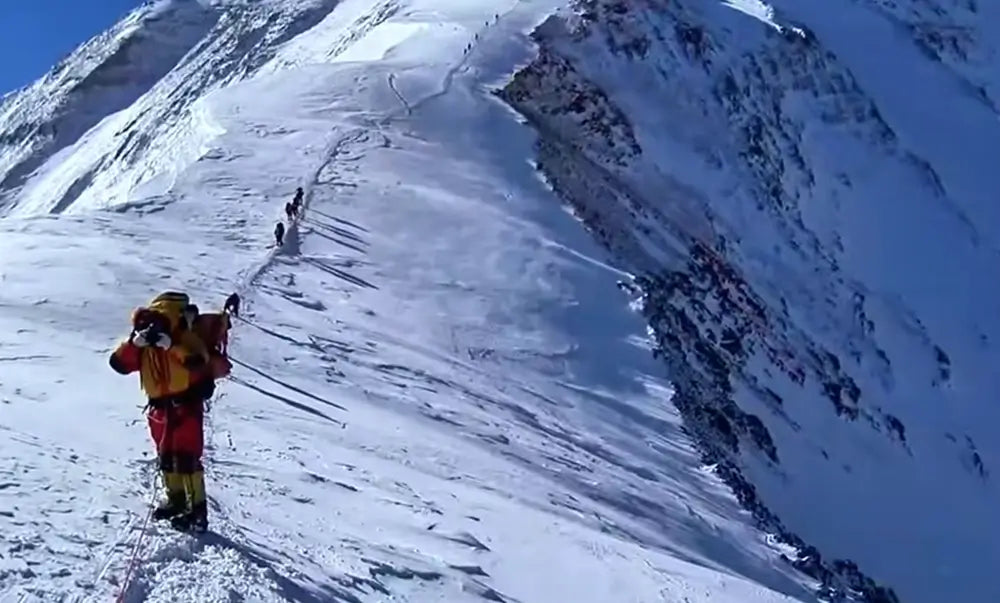
Above the high camps, the route joins the Everest Northeast Ridge, the defining feature of the north side. Unlike the south route, which passes through the Khumbu Icefall and Western Cwm, the north route spends a long time on exposed ridge terrain.
The difficulty here is sustained exposure. The altitude is extreme, the air thin, the wind strong and the ground a mix of snow, ice, rock and fixed rope sections. A move that might feel straightforward at lower altitude becomes far more serious above 8500 metres.
This is where the north side earns its reputation. It is not always one dramatic obstacle. It is the long demand of staying calm and moving efficiently along a high, exposed ridge.
The Three Steps
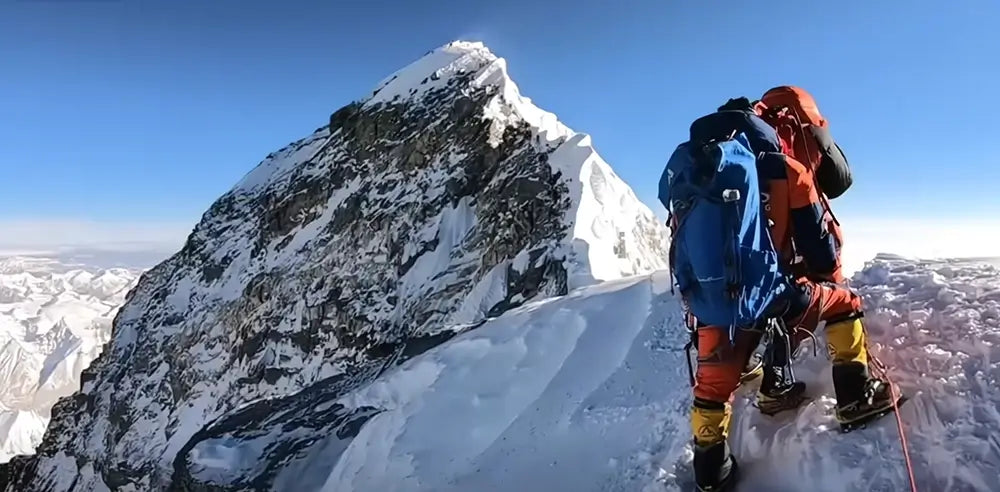
The most famous features on the north route are the Everest Three Steps on the Northeast Ridge: the First Step, Second Step and Third Step.
First Step
The First Step lies around 8560 metres and consists of rock and blocky terrain. Fixed ropes are normally used, but the altitude makes every movement tiring.
Second Step
The Everest Second Step is the most famous and symbolic obstacle on the north side. It lies around 8610 to 8650 metres and includes a steep rock section. Modern climbers normally use a fixed ladder system, but that does not make it easy.
At low altitude, a ladder or rock step might not sound serious. Above 8600 metres, wearing high-altitude boots, thick gloves, oxygen gear and moving in wind, it becomes a major test.
Third Step
The Third Step lies higher, around 8710 metres. It may be less famous than the Second Step, but at that altitude, every rise costs energy. After the Third Step, climbers still have to continue toward the summit.
The Three Steps are remembered not just because they are rocky obstacles, but because they appear when the human body is already deeply stressed by altitude.
Summit Day
Summit day on the north side usually begins from the highest camp during the night or very early morning. Climbers move toward the Yellow Band, the Northeast Ridge, the First Step, Second Step, Third Step and then the summit.
Some expedition descriptions suggest summit day from around 8300 metres may take 14 to 18 hours or longer, depending on weather, route conditions, team speed and individual strength.
The key words for the north side summit day are long and exposed. Climbers must manage oxygen, warmth, hands and feet, fixed rope transitions, possible queues and turnaround time.
The summit itself is small, and climbers cannot stay long. A successful climb is not reaching the top; it is returning safely to high camp and then lower.
North Side Compared with the South Side
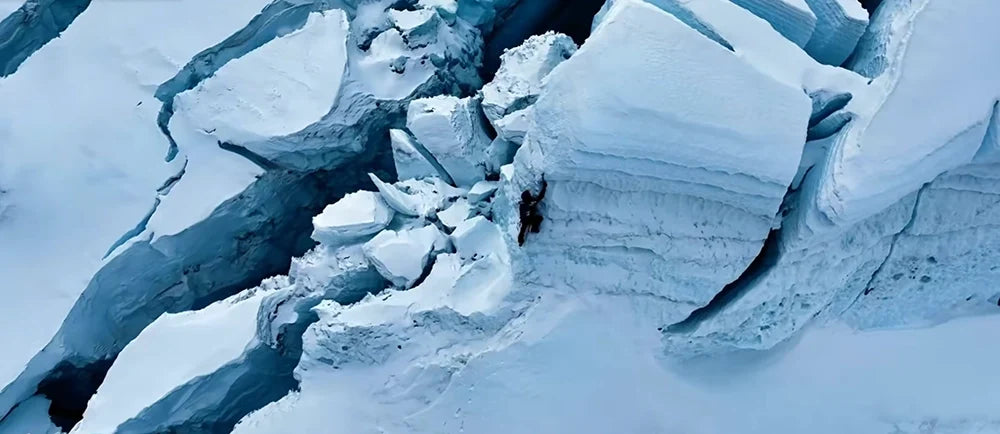
The north side’s best-known advantage is avoiding the Khumbu Icefall. On the south side, the Icefall is a major moving glacier hazard. The north side does not have that section.
But the north side has its own costs:
- Colder temperatures
- Stronger winds
- More exposed ridge terrain
- Longer summit day
- Higher and harsher camps
- Technical pressure at the Three Steps
- More difficult rescue
- Stricter access and permits
Calling the north side “safer” is too simple. It reduces one category of danger but adds others.
Who Is the North Ridge Route For
The Everest North Ridge route is not for beginners. It is suitable only for climbers with high-altitude experience, fixed rope skills, strong endurance, cold weather experience and calm decision making.
A climber considering the north side should usually have:
- Previous 7000m or 8000m experience
- Crampon, ascender and descender skills
- Ability to move in high wind and extreme cold
- Comfort on exposed ridges
- Clear retreat judgement
- Legal permits and professional support
- Acceptance of strict regulation and changing conditions
For ordinary travellers, the Tibet Everest viewing area is already a powerful destination. The north side climbing route is a completely different world.
Final Thoughts
The Everest North Ridge route climbs from Tibet through North Base Camp, the Rongbuk Glacier area, Advanced Base Camp, the North Col, high camps, the Northeast Ridge, the First Step, Second Step, Third Step and finally the summit.
It avoids the Khumbu Icefall, but it is not easier in any simple sense. Its challenges are cold, wind, exposure, high-altitude technical terrain, the Three Steps and difficult rescue conditions.
The south side is often seen as the more developed commercial route. The north side feels colder, harder, more austere and more exposed.
On Everest’s north side, the challenge is not only height. It is wind, time, oxygen, low temperature and whether a climber can still make good decisions in the death zone.

Leave a comment
All comments are moderated before being published.
This site is protected by hCaptcha and the hCaptcha Privacy Policy and Terms of Service apply.