
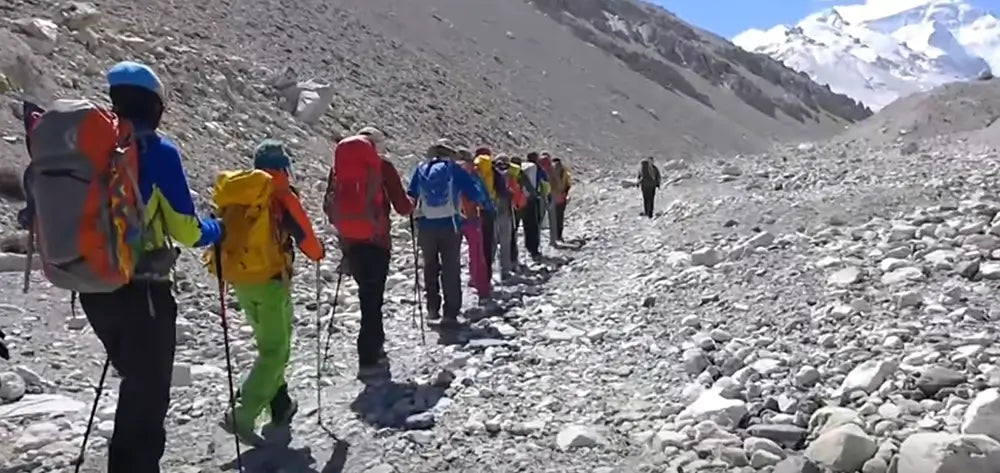
You do not need to be a mountaineer to trek to Everest Base Camp. You do not need ice climbing skills or elite athletic ability. But the EBC trek is still not something to treat casually.
The trek usually lasts 12 to 14 days. You may walk 4 to 7 hours a day, with climbs, descents, rough trail, cold tea houses and altitude above 5000 metres. Many trekkers are not defeated by one steep hill. They are worn down by repeated days, poor sleep, low appetite and thin air.
The goal of Everest Base Camp training is not to make you the fastest person on the trail. It is to make you steady, durable, able to recover, comfortable with a daypack and strong enough to descend without wrecking your knees.
Quick Answer
For the Everest Base Camp Trek, start training at least 8 to 12 weeks before departure. If your fitness base is low, begin 16 to 20 weeks ahead.
Your training should include:
- Three to four cardio sessions per week
- One or two longer hikes per week
- Hill, stair or incline treadmill training
- Leg, glute and core strength
- Downhill and knee-control training
- Daypack walking
- Breaking in boots and socks
- Practising with trekking poles
- Tapering during the final two weeks
In simple terms, EBC training is not a sprint. It is about becoming trail-durable.
How Fit Do You Need to Be
Many ordinary people complete the Everest Base Camp Trek. But “ordinary people can do it” does not mean “no training needed”.
You should be able to:
- Walk for many days in a row
- Trek 5 to 7 hours per day
- Handle steady uphill and downhill sections
- Carry a 4 to 7 kg daypack
- Keep knees and ankles stable on rough trail
- Keep moving after mediocre sleep
- Walk patiently without racing
Destination Himalaya Treks describes the required fitness as basic physical endurance to cover daily walking of around 5 to 6 hours, with frequent ascents, descents and uneven terrain. That is a good summary. EBC does not test explosive power. It tests consistency.
Cardio Is the Foundation
High-altitude trekking needs aerobic endurance. You need to move for a long time at a moderate effort, not sprint for 20 minutes and stop.
Useful cardio includes:
- Brisk walking
- Easy running
- Cycling
- Swimming
- Elliptical trainer
- Stair machine
- Long hikes
- Trail walking
REI’s hiking training advice suggests regular cardio sessions and, in the final two weeks before a major hike, replacing some cardio with longer pack-carrying hikes. That idea works well for EBC.
If you are starting from zero, do not begin with hard running. Start with 30 to 45 minutes of brisk walking, three or four times per week. Then gradually increase duration, hills and pack weight.
Hill Training Is Better Than Flat Running Alone
The EBC route includes lots of climbing and descending. Flat running helps your heart and lungs, but it does not fully prepare your legs for mountain trail.
Better EBC-specific training includes:
- Weekend hill walks
- Stair climbing with a pack
- Incline treadmill walking
- Stair machine sessions
- Hill repeats
- Bridges, steps and slopes in your city
If you live far from mountains, stairs and incline treadmills can still help. The key is teaching your legs to climb steadily.
Do not train only for speed. On EBC, the best uphill rhythm is small steps, steady breathing and controlled effort. Practise that before Nepal.
Do Not Ignore Downhill Training
Many trekkers train for uphill but forget that the return from EBC involves long descents. Downhill walking stresses knees, toes, quadriceps and ankles.
Weak downhill control can lead to:
- Knee pain
- Toe pain
- Sore quadriceps
- Ankle instability
- Slower descent
- More falls when tired
Useful training includes:
- Real mountain descents
- Controlled stair descents
- Lunges
- Single-leg squats
- Step-downs
- Eccentric leg work
- Downhill practice in trekking boots
Practise with trekking poles too. Do not wait until Nepal to learn them. Adjusting pole length and using them differently uphill and downhill can reduce knee strain.
Strength Training
EBC is not a gym contest, but strength makes trekking more comfortable. REI’s backpacking conditioning advice focuses on core and major leg muscles because they carry much of the trail load. Alpine Ascents also recommends a mix of cardiovascular, climbing, strength and flexibility conditioning for EBC.
Focus on:
- Quads
- Glutes
- Hamstrings
- Calves
- Core
- Lower back
- Shoulder and upper back stability
Good exercises include:
- Squats
- Lunges
- Step-ups
- Deadlifts or glute bridges
- Calf raises
- Planks
- Side planks
- Farmer carries
- Rows or resistance band pulls
Two strength sessions per week is enough for many trekkers. Do not train so hard that you cannot walk the next day. EBC needs endurance strength, not maximum lifting numbers.
Train With a Backpack Gradually
If you hire a porter, you may carry only a daypack with water, rain gear, warm layers, medicine, camera and snacks. That might be 4 to 7 kg. If you carry all your own gear, it will be heavier.
Build pack weight gradually:
Stage one: walk with an empty or light pack.
Stage two: add 3 to 5 kg.
Stage three: increase toward your real daypack weight.
Stage four: wear your trekking boots and practise 4 to 6 hour hikes.
Do not suddenly carry a heavy pack up hills. Shoulders, lower back, knees and feet all need time to adapt.
Break In Your Boots
Boot break-in is as important as fitness.
New boots on the EBC trail are a common mistake. They may rub, squeeze toes, irritate ankles or work badly with your socks. Finding that out in Nepal is too late.
Before departure, use your actual boots for:
- Several 1 to 2 hour walks
- One or two half-day hikes
- One long hike
- Downhill testing
- Thick sock testing
- Pack-carrying walks
If there are hot spots, solve them early. Blisters are a small issue at home and a daily misery on the trail.
A Practical 8 to 12 Week Training Framework
This is a general framework, not medical advice. If you have heart, knee, lung or chronic health issues, speak with a doctor first.
Weeks 1 to 4 Build the Base
Each week:
- 3 brisk walks, easy runs or bike sessions of 30 to 45 minutes
- 1 longer walk or hike of 60 to 90 minutes
- 2 basic strength sessions
- 1 to 2 rest days
The goal is routine, not exhaustion.
Weeks 5 to 8 Add Climbing
Each week:
- 2 to 3 cardio sessions of 45 to 60 minutes
- 1 hill, stair or stair-machine session
- 1 long hike of 2 to 4 hours
- 2 strength sessions
- Start carrying close to daypack weight
This phase teaches your legs to climb and descend.
Weeks 9 to 11 Simulate the Trek
Each week:
- 2 moderate cardio sessions
- 1 climbing session
- 1 long pack hike of 4 to 6 hours
- 1 to 2 strength maintenance sessions
- Try two consecutive training days
EBC fatigue is cumulative. A long Saturday hike followed by an easier Sunday walk is useful preparation.
Week 12 Taper
Do not train hard in the final week. Reduce volume, walk lightly, stretch, sleep well and organise gear. You want to arrive healthy, not sore.
What If You Only Have One Month
One month is not ideal, but you can still improve.
Focus on:
- 4 to 5 days per week of brisk walking or hills
- One long weekend hike
- Two basic strength sessions
- Immediate boot break-in
- Keeping your pack light
- Choosing a slower 14-day itinerary
- Hiring a porter
- Not cutting acclimatisation days
A month will not make you a strong trekker, but it is much better than doing nothing. Do not panic-train so hard that you get injured.
Can You Pre-Acclimatise
If you live at low altitude, you cannot fully prepare your body for 5000 metres. Hypoxic tools or altitude travel may help some people, but for ordinary EBC trekkers, itinerary matters most.
What you can do is:
- Build aerobic fitness
- Practise slow uphill rhythm
- Avoid compressing the route
- Keep Namche and Dingboche acclimatisation days
- Walk slowly after arrival
- Listen to your guide about altitude symptoms
Fitness does not prevent altitude sickness completely. But poor fitness makes altitude feel harder. Training is necessary, not a guarantee.
Mental Preparation Counts
EBC is not only physically tiring. You may face:
- Cold rooms
- Basic toilets
- Unreliable WiFi
- Repetitive food
- Poor sleep
- Flight delays
- Cloudy weather hiding the mountains
- Other trekkers moving faster than you
Training can include patience. Long slow walks, safe bad-weather hikes, back-to-back training days and completing plans calmly when uncomfortable all help.
Many trekkers discover that the most useful quality is not being strong. It is not panicking.
Common Training Mistakes
Only Running
Running helps, but EBC also needs hills, descents, pack carrying and leg strength.
Starting Too Late
Beginning two or three weeks before departure is not enough. Eight to twelve weeks is much better.
Ignoring Rest
More training is not always better. Knee pain, foot pain or Achilles discomfort should be taken seriously.
Not Using Real Gear
Boots, socks, pack and trekking poles should be tested before the trek.
Walking Too Fast on Day One
Even if you trained well, go slowly in Nepal. Altitude is not a gym.
Conclusion
How should you train for the Everest Base Camp Trek? Not by running a marathon or doing a few heroic workouts. Use 8 to 12 weeks, ideally more, to build aerobic endurance, hill strength, downhill control, leg stability and pack comfort.
The best EBC body is not necessarily fast. It is durable. It can walk for hours, wake up and do it again, climb slowly without racing, descend without destroying the knees and stay calm after a poor night of sleep.
EBC training is really training a rhythm. Once you have that rhythm, the Khumbu trail becomes less of a struggle and more of a journey you can actually look up and enjoy.

Leave a comment
All comments are moderated before being published.
This site is protected by hCaptcha and the hCaptcha Privacy Policy and Terms of Service apply.