
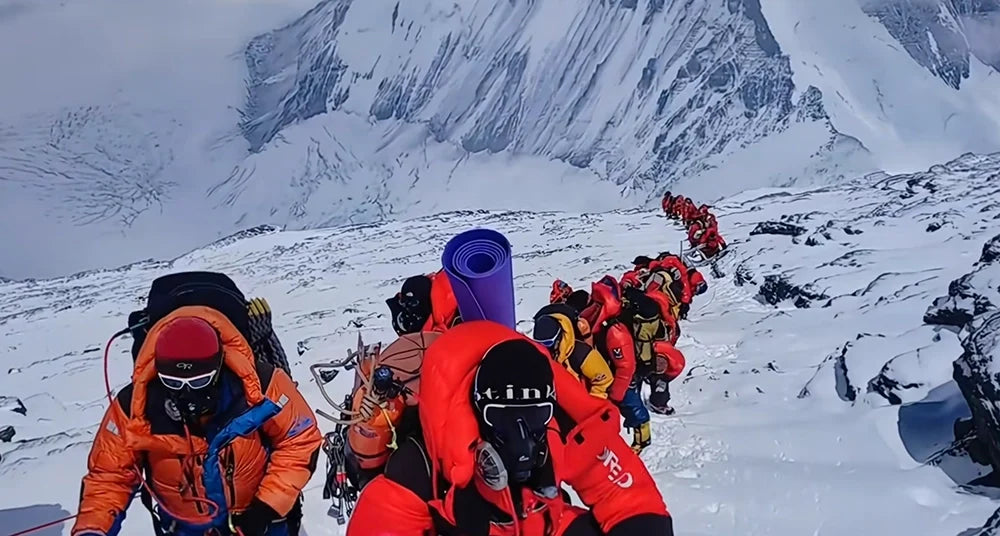
Many people imagine climbing Everest as a simple line from Base Camp to the summit. You arrive at Everest Base Camp, move through the camps, climb higher each day and eventually stand on top.
The real expedition is not like that. Everest is more like a two-month cycle of acclimatisation, waiting, climbing, descending and waiting again. Most traditional Everest expeditions take about 6 to 10 weeks, often around 55 to 70 days. The exact duration depends on route, weather, acclimatisation strategy, expedition style and whether pre-acclimatisation is used.
The most time-consuming part of Everest is not the final few hundred metres. It is giving the human body enough time to survive them.
Quick Answer
Climbing Everest usually involves:
- Travel to Nepal or Tibet: several days
- Reaching Base Camp: about 1 to 2 weeks
- Base Camp preparation: several days
- Acclimatisation rotations: about 3 to 5 weeks
- Waiting for a weather window: days to weeks
- Final summit push and descent: about 4 to 7 days
- Return to the city and departure: several days
So if someone asks “how many days does Everest take?”, the simplest answer is this: a real Everest expedition is planned in months, not days.
Why Climbers Cannot Go Straight from Base Camp to the Summit
Everest Base Camp on the Nepal side is already around 5364 metres. For many people, that altitude alone can cause headache, poor sleep, loss of appetite and shortness of breath. The summit is above 8848 metres, and the route passes the Khumbu Icefall, Camp 1, Camp 2, the Lhotse Face, Camp 3, Camp 4 at the South Col and the death zone.
If a climber moves too quickly from low altitude to high altitude, the risk of severe altitude illness rises sharply. High-altitude cerebral edema and high-altitude pulmonary edema can be fatal. Everest expeditions move slowly because the body needs time.
The basic principle is “climb high, sleep low”. Climbers go to higher altitude to stimulate adaptation, then descend to recover. Repeating this process helps the body improve its response to thin air.
Stage One Arriving in Kathmandu or Lhasa
Most south side expeditions begin in Kathmandu, Nepal. This stage may look like ordinary travel, but it includes important work:
- Team meeting
- Gear checks
- Insurance confirmation
- Permit and document handling
- Oxygen, food and transport planning
- Last-minute shopping and repairs
- Expedition briefings
Experienced climbers do not treat these days as empty time. A poor-fitting boot, missing connector, insurance issue or broken item is much easier to fix in Kathmandu than at Base Camp.
North side expeditions through Tibet have a different schedule, often involving Lhasa, Shigatse, Tingri and Everest north side Base Camp. Access depends on current policy, permits and expedition arrangements.
Stage Two Trekking to Everest Base Camp
On the Nepal side, the classic approach begins with a flight from Kathmandu or Ramechhap to Lukla, then a trek through places such as Phakding, Namche Bazaar, Tengboche, Dingboche, Lobuche and Gorak Shep before reaching Everest Base Camp.
This approach trek usually takes about 8 to 12 days, depending on the schedule. Many teams include acclimatisation days in Namche Bazaar and Dingboche. For climbers, this is not just a scenic warm-up. It is the first phase of altitude adaptation.
Moving too fast is not a sign of strength. A good pace allows the body to accept altitude gradually. Some climbers damage their whole expedition by arriving at Base Camp already exhausted.
Stage Three Living at Base Camp
Once climbers reach Base Camp, the expedition begins properly. Base Camp is not a normal campsite. It is the operational centre of the south side climb.
Climbers use this time to:
- Rest and recover
- Check high-altitude gear
- Practise fixed-rope systems
- Use crampons and ascenders
- Learn Icefall route procedures
- Wait for route conditions
- Monitor body response
- Confirm plans with guides and Sherpa teams
Some teams spend several days at Base Camp before beginning the first rotation. It may look slow, but it helps climbers shift from trekking mode into climbing mode.
Stage Four Acclimatisation Rotations
Acclimatisation rotations are the main reason Everest takes so long.
Alan Arnette’s 2026 Everest coverage explains that modern Everest teams typically complete two to five rotations, sometimes supported by climbs of nearby peaks. Each operator has a different approach, but a common Nepal side pattern may include:
First Rotation
Climbers move from Base Camp through the Khumbu Icefall to Camp 1 or Camp 2, sleep one or more nights, then return to Base Camp. The first trip through the Icefall is often unforgettable: ladders, crevasses, ice towers, cold starts and real exposure.
Second Rotation
Climbers return to Camp 1 and Camp 2, often spending more time at Camp 2. Some teams climb toward the Lhotse Face or touch higher altitude near Camp 3 for additional acclimatisation.
Third Rotation or High-Point Training
Some teams make another higher rotation. Others use nearby peaks such as Lobuche East or Island Peak to reduce repeated trips through the Khumbu Icefall. Each strategy has trade-offs.
The point of a rotation is not to “climb halfway early”. It is to teach the body and mind how to function on the mountain. Every climb up is expensive in energy, and every descent is part of recovery.
Stage Five Rest and Waiting for the Weather Window
After rotations, climbers often descend to lower villages such as Pheriche or Dingboche to rest. Lower altitude means better sleep, better appetite and better recovery.
Then comes the waiting.
A weather window may arrive in a few days, or it may take much longer. Teams monitor jet stream winds, snowfall, temperature, visibility and the progress of the monsoon. As discussed in the previous article, the weather window decides whether a summit attempt is possible.
This is one of the mentally hardest parts of Everest. You have trained for years, paid a large amount, acclimatised successfully and still cannot go until the mountain allows it.
Stage Six The Final Summit Push
When a suitable window appears, teams begin the summit push. A common Nepal side pattern is:
- Base Camp to Camp 2
- Rest or wait at Camp 2
- Camp 2 to Camp 3
- Camp 3 to Camp 4 at the South Col
- Night departure from Camp 4 for the summit
- Summit and descend to Camp 4, Camp 3 or Camp 2
- Return to Base Camp
The final summit phase usually takes about 4 to 7 days, depending on weather, team speed, route conditions and crowding.
Many people think summit day starts at Camp 4. In reality, the summit phase begins when climbers leave Base Camp again. From that point, sleep, appetite and oxygen are limited, and every day draws down the strength built earlier in the expedition.
How Long Is Summit Day
From Camp 4 to the summit and back, summit day often takes many hours. Some climbers may take 12 to 16 hours. Others take longer. Speed depends on fitness, weather, oxygen, route conditions, crowding and team management.
Teams usually leave at night to reach the summit in the morning and descend with enough daylight. A very late summit is a warning sign because weather can change, oxygen can run low and fatigue increases.
On Everest, speed is not about showing off. It is about reaching key points within safe time limits and still having enough strength to descend.
Why Some Expeditions Take Only Around 45 Days
Some modern operators use rapid ascent strategies. Alpenglow Expeditions has described a Rapid Ascent model of about 45 days, using pre-acclimatisation at home in hypoxic tents to reduce time on the mountain.
This can work for specific climbers and specific teams, but it does not mean Everest is a short holiday. Pre-acclimatisation requires equipment, planning, discipline and extra cost. It also does not remove the need for genuine high-altitude experience.
For most climbers, the traditional 6 to 10 week timeline remains more realistic.
How Long Does the North Side Take
The Tibet north side has a different approach. Road access can bring climbers closer to Base Camp than the Nepal side trek. However, the north side still requires acclimatisation, rotations, route preparation, waiting for weather and a summit push.
So the north side is not a “few days to the top” option. The main time cost is not simply reaching Base Camp. It is preparing the body and waiting for the right conditions.
Access to the north side can also change depending on current policy and permits, especially for foreign climbers.
How Much Time Should Ordinary Climbers Reserve
If Everest is a real goal, do not plan it like a one-month vacation. A more realistic time budget is:
- Expedition itself: 6 to 10 weeks
- Training and equipment preparation: months to years
- Recovery after returning home: several weeks
- Buffer for delays: ideally 1 to 2 weeks
Everest is not a good project for a tight return flight. Weather, flights, health, permits and route conditions can all shift. Lukla flights are also often delayed by mountain weather.
A schedule with no flexibility can turn Everest into a constant source of stress.
Why a Longer Expedition Is Not Always Easier
Two months sounds generous, but Everest is not a holiday. A long expedition creates its own pressure:
- Time away from family and work
- Anxiety while waiting at Base Camp
- Poor sleep at altitude
- Fatigue from repeated climbs and descents
- Loss of appetite and weight
- Team mood changes
- Obsession with weather forecasts
Some climbers are not defeated by one hard day. They are worn down by weeks of uncertainty. Everest requires the ability to stay patient and sensible for a long time.
Conclusion
How long does it take to climb Everest? A traditional expedition usually takes about 6 to 10 weeks, with many teams planning around two months. The reason is not that the route is extremely long in distance. It is that acclimatisation, logistics, weather windows and a safe summit push all take time.
One of the hardest things to understand about Everest is that slowness is part of safety. Climbers who rush often lose to altitude before they ever lose to the mountain.
If Everest is your dream, do not ask only how fast you can summit. Ask whether you are willing to give your body, skills, team and weather enough time to align.
The highest mountain in the world does not adjust itself to a human calendar.

Leave a comment
All comments are moderated before being published.
This site is protected by hCaptcha and the hCaptcha Privacy Policy and Terms of Service apply.