
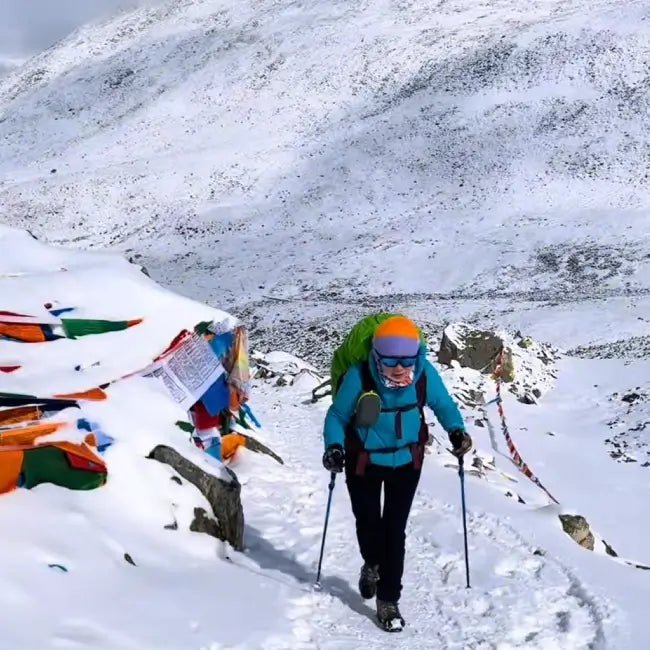
Many first-time trekkers think trekking poles are optional extras. Once they are actually on the trail, though, they often discover that poles are one of the most useful items in the pack.
The Everest Base Camp trek is not a technical climb, but it is long, repetitive and tiring. The trail keeps going up and down, the air gets thinner, recovery is slower and the downhill sections can be hard on the knees. In that setting, trekking poles do more than people expect.
They do not carry you. But they can make the trek feel much smoother.
Quick Answer
Trekking poles are very helpful on the Everest Base Camp trek, especially if you have sensitive knees, a heavier pack, little hiking experience or a tendency to get tired on descents. They improve balance, help with rhythm and take some load off your legs.
If you only bring one support item for the trek, poles are often more useful than an extra piece of clothing.
Why EBC Is a Good Trek for Poles
The challenge on the Everest Base Camp route is not one single steep section. It is the constant pattern of climbing, descending and repeating the cycle day after day.
That matters because:
- Your legs are always working
- Your body has less recovery at altitude
- Downhill sections are tougher than they look
- Your balance matters on stone steps, bridges and loose trail
For long, high-altitude walks, trekking poles are less about performance and more about efficiency. They help you stay steady and save energy.
How to Use Trekking Poles Uphill
Uphill, poles should help you keep a rhythm and share part of the load with your upper body.
A simple method:
- Shorten the poles slightly
- Plant them a little ahead of your body
- Keep your elbows naturally bent
- Step and plant in a steady rhythm
- Do not lean your whole body weight onto them
On long climbs such as the approach to Namche Bazaar, the walk around Dingboche and the climb to Kala Patthar, poles can make a noticeable difference.
How to Use Trekking Poles Downhill
Downhill is where many trekkers really notice the benefit.
Use them to:
- Reduce knee stress
- Improve balance
- Control your speed
- Keep your steps shorter on rough ground
A few simple tips:
- Lengthen the poles a little
- Plant them before each step
- Avoid stabbing the ground too hard
- Keep your body slightly forward, not leaning back
- Slow down on loose gravel or wet stone
The long descents back to Namche and Lukla are exactly where poles become valuable.
What About Flat Sections and Suspension Bridges?
On flatter ground, you do not need to use them constantly. But they can still help with balance on muddy, rocky or uneven sections.
Suspension bridges need extra care:
- Do not swing the poles around
- Do not block other trekkers
- Keep the poles under control
- If the bridge is busy, briefly lift or shorten them
The bridges on the EBC route are long, and the wind can make them feel lively. Poles can help, but they should never become a hazard.
What Kind of Trekking Poles Should You Choose?
For the Everest Base Camp trek, a light, adjustable and reliable pole is usually the best choice.
Two common styles are:
Telescopic poles
These are adjustable and easy to adapt to uphill or downhill sections. They are a solid choice for most trekkers.
Folding poles
These are compact and often lighter, which is good if you care about weight and packing size.
Whatever you choose, look for:
- Strong locking
- Comfortable grips
- Durable tips
- Easy packing
- A design you can use with gloves
For Everest Base Camp trek pole tips, the most important thing is not luxury. It is reliability.
How to Set the Right Length
A simple rule is to hold the poles so your elbows are around 90 degrees when standing in a neutral position.
Then adjust slightly:
- Flat trail: comfortable length
- Uphill: slightly shorter
- Downhill: slightly longer
- Long trekking days: whatever reduces shoulder strain
If the poles are too long, you will shrug your shoulders. If they are too short, you will hunch. The right length feels natural.
Who Benefits Most From Trekking Poles?
Poles are especially helpful if you:
- Have sensitive knees
- Are carrying a heavier pack
- Do not hike often
- Want to walk more steadily
- Plan to take a slower pace
- Have had ankle issues before
- Want to reduce downhill fatigue
Even strong hikers often end up liking poles once the route gets long and repetitive.
Who Might Skip Them?
Some people find poles annoying at first, especially if they are not used to coordinating both hands while walking. On short flat sections, in villages or while taking photos, they can feel unnecessary.
That does not mean they are useless. Many trekkers only appreciate them properly on the second or third day, when the downhill starts to bite.
Easy-to-Miss Details
Tips and rubber caps
Check the pole tips before you go. Rocky trails wear them down. Rubber caps are handy if you do not want constant metal-on-stone noise.
Wrist straps
Use the straps properly. Your hand should go up through the strap from below so the strap supports your grip rather than trapping it.
Windy days
In strong wind, keep the poles under control. Slow, compact movement is better than letting them swing loosely at your sides.
Do not grip too hard
Holding the poles too tightly makes your hands and forearms tire faster. Learn to relax your grip on easier ground.
Can You Do EBC Without Poles?
Yes. Poles are not mandatory. But if you ask whether they are worth carrying, the answer is usually yes.
Going without them may keep your setup simpler, but you lose a very practical tool for reducing strain and improving balance. On the long downhill days especially, many trekkers wish they had brought them.
Final Thoughts
Trekking poles are not decoration on the Everest Base Camp trek. They are a genuinely useful tool. They can reduce knee stress, improve balance, help with pacing and make the long climbs and descents feel more manageable.
If you want the EBC trek to feel smoother, poles are often more valuable than one extra clothing item. They will not make the trek easy, but they can make it kinder.
A steady trek is usually a better trek. Trekking poles help with that.

Leave a comment
All comments are moderated before being published.
This site is protected by hCaptcha and the hCaptcha Privacy Policy and Terms of Service apply.