
Quick Answer
Survival knives and a bushcraft blade are not automatically illegal to own in the UK, but carrying one in public is tightly controlled. For camping, you need a genuine and explainable reason if the knife is a fixed blade, locking knife, or has a blade over 3 inches.
The safest everyday option is usually a small, non locking folding pocket knife with a cutting edge of 3 inches or less. Larger camping knives may be legal in the right context, but the reason, location, transport method and behaviour all matter.
This article is general information, not legal advice.
Why UK Knife Law Matters for Campers
A knife can be a normal camping tool. It can cut cord, prepare food, sharpen kindling, open packaging or help with small repairs. But in UK law, the same item can create serious problems if it is carried without a good reason.
That is why anyone buying a bushcraft blade for camping should understand the difference between owning a knife, transporting a knife, and carrying a knife in public.
A blade packed safely in your camping kit for a woodland skills course is very different from the same blade clipped to your belt in a town centre.
What Knives Can You Carry Without a Specific Reason
According to GOV.UK, the main exception is a folding pocket knife that has a cutting edge no longer than 3 inches and does not lock.
That means a small Swiss Army style knife is usually the lowest risk choice for general camping use, provided it is genuinely non locking and within the size limit.
Important Detail
A locking knife is not treated the same as a simple folding pocket knife. Even if the blade is under 3 inches, a locking mechanism makes the rules stricter. If it locks open, you need a good reason to carry it in public.
Are Fixed Blade Survival Knives Legal for Camping
A fixed blade survival knife can be legal to own and use in suitable circumstances, but carrying it in public without good reason can be an offence.
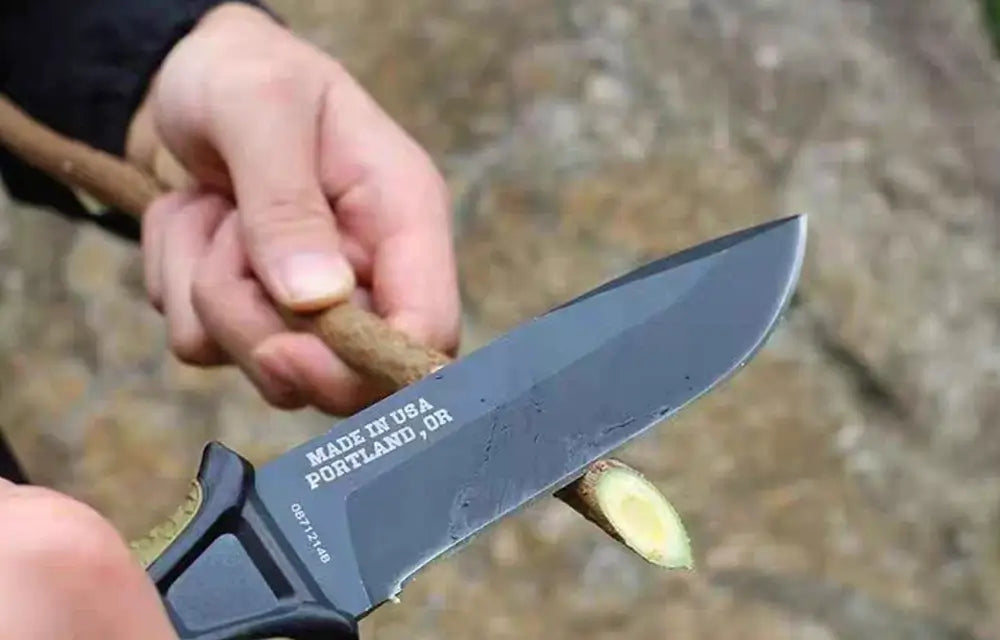
For a camping trip, a good reason might include practical outdoor tasks such as food preparation, cutting cord, wood processing in an appropriate setting, or bushcraft training. But the reason must fit the situation.
For example, carrying a bushcraft blade deep in a rucksack while travelling directly to a campsite or bushcraft course is easier to explain than wearing it openly in a supermarket, pub, train station or town centre.
What Counts as a Good Reason
The Crown Prosecution Service explains that lawful authority or reasonable excuse can be a defence, but the circumstances matter. In practice, you may need to explain why that specific knife was needed, why you had it in that place, and why it was being carried in that way.
For camping, good practice is simple:
- Carry the knife only when it is genuinely needed
- Keep it packed away during travel
- Use a sheath or secure storage
- Do not carry it openly in public areas
- Do not take it into shops, pubs or towns after camp
- Do not carry it for self defence
- Be ready to explain the camping purpose calmly
A camping knife legal UK situation depends heavily on context.
What Not to Bring
Some knives and weapons are banned or especially risky. GOV.UK lists several prohibited weapons, including flick knives, butterfly knives and disguised knives. Wood to Water also warns campers to avoid large blades, machetes and anything that looks more like a weapon than a tool.
For most UK camping trips, a huge survival knife is unnecessary. A small folding knife, multitool or compact fixed blade used responsibly is usually more practical.
Safer Bushcraft Blade Habits
If you do take a bushcraft blade camping, treat it as a tool, not a display item.
Pack it inside your rucksack. Keep it sheathed. Use it only at camp or in a suitable outdoor setting. Put it away when not in use. Carry a first aid kit. If children are present, keep it supervised and stored safely.
Do not post videos or photos that make the knife look threatening. That may sound obvious, but presentation matters. A camping tool should look like part of a responsible outdoor kit.
Best Knife Choice for a UK Camping Trip
For most campers, the best choice is not the biggest knife. It is the least complicated tool that does the job.
A sensible setup might be:
- Small non locking folding knife for simple tasks
- Multitool for repairs
- Compact fixed blade only for genuine bushcraft use
- Folding saw instead of a large chopping blade
- Stove instead of relying on firewood processing
For typical UK campsites, a survival knife is rarely needed. For bushcraft training, woodland camping or outdoor skills practice, a fixed blade may make more sense, but it should still be transported and used carefully.
Final Thoughts
So, are survival knives legal in the UK? Sometimes, but the answer is not a simple yes. A bushcraft blade can be a useful camping tool, but UK knife law focuses on why you have it, where you have it, and how you are carrying it.
For most camping trips, choose the smallest practical tool, pack it securely, use it only for legitimate camp tasks, and never carry it for self defence. If you are unsure whether you can justify the knife, leave it at home.



Leave a comment
All comments are moderated before being published.
This site is protected by hCaptcha and the hCaptcha Privacy Policy and Terms of Service apply.